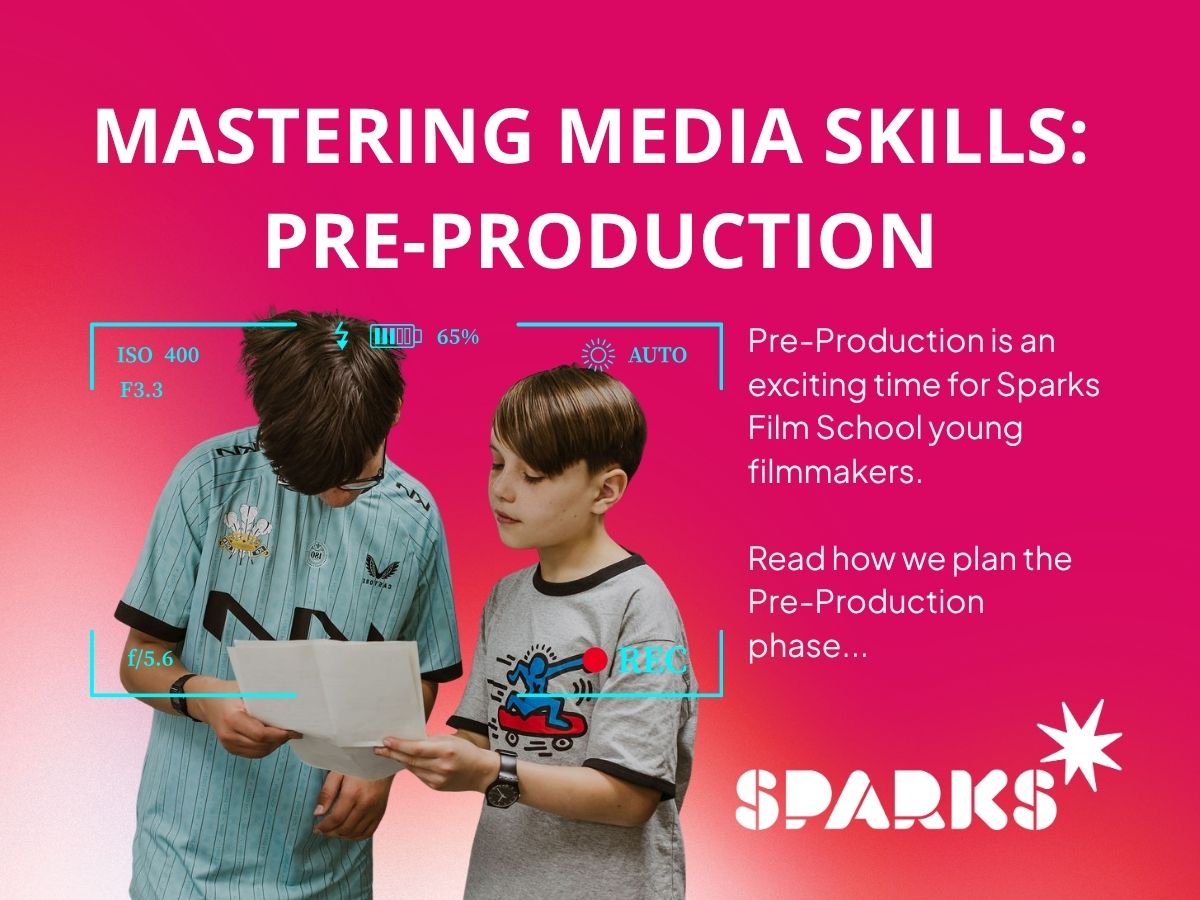
Take a look at what happens before ‘Action’ is called at Sparks Film School
Behind every finished film at Sparks Film School lies careful planning, creative discussion, and experimenting with different techniques during the ever important pre production phase.
But what exactly does pre-production mean? Simply put, it is the planning phase of a film. It is the bridge between a wild, brilliant idea and the first day of production, when everyone arrives on set ready to shoot.

At Sparks Film School, our class terms usually start with masterclass sessions, where students explore specific technical skills and then pitch creative story ideas (see our blog on the exciting Pitching Week).
Once the crews have their concept for their final film, we dive headfirst into the pre-production phase of filmmaking. This is where the real creative problem-solving happens.
Here is a look at the essential pre-production steps our students cover, and why they are so vital for a young filmmaker’s development.

1. Creating a Scene List (The Shot List)
The crew works together to break the script down into a scene list or “shot list.” This is a checklist of every single camera angle needed to tell the story. This can be added to and changed as they continue with the production process, but its a great starting point for the structure of a film.
- What they are learning: organisation, critical thinking, and communication.
- Why it’s valuable: making a shot list ensures the entire crew understands the story and what needs shooting before day one. The young filmmakers learn how to break a massive project down into manageable, bite-sized tasks. Plus, having a plan actually creates a smoother collaborative process, leaving plenty of room for discussion and spontaneous creative changes on set.
2. Storyboarding Scenes
Storyboarding is the art of drawing out your film, frame by frame, like a comic book.
- What they are learning: visual literacy and spatial awareness.
- Why it’s valuable: young filmmakers learn that filmmaking is a visual language. Translating words from a script into a drawing forces them to think about composition, framing, and how a story flows visually. It’s a fantastic way for visual learners to lead the creative direction of a project.

3. Location Scouting
Our students don’t just film against the nearest blank wall (especially not in some of the amazing venues our crews use). They become Location Scouts, exploring their environment to find the perfect backdrop for their scenes.
- What they are learning: how to assess and evaluate, how to adapt and interpret, how to make decisions
- Why it’s valuable: students learn to look at the world through a director’s lens. They evaluate how a location’s lighting, background noise, or layout might determine the shot types they use. A spooky school hallway might inspire a creepy tracking shot, while a wide-open playground might be perfect for a dramatic wide angle. It teaches them to use their surroundings to add depth and mood to the story. We have even had films created in the past by crews that have been based solely on the location and how it appears, e.g. period dramas or high school comedies

4. Planning Crew Roles
Every session, students map out who is doing what. These roles are incredibly flexible, nothing is set in stone, and everyone is encouraged to try everything.
- The Actors and Director: actors and the director rehearse dialogue and blocking (movement) in the room. This builds empathy, public speaking confidence, and performance skills.
- The Location Scouts: armed with a test camera, they scout the venue, filming test footage to see how the camera reacts to the space.
- The Camera Operators: they take the lead on planning the technical side, filling in the storyboard, and figuring out where the equipment needs to stand.
- Why it’s valuable: This structure teaches leadership, trust, and flexibility. By swapping roles, young filmmakers learn to appreciate every single job on a set, encouraging them to discover hidden talents they never knew they had.
5. Experimenting with Masterclass Techniques
Pre-production is the perfect sandbox for testing out ideas.
Before the shoot days, the crews spend time experimenting with techniques covered in our earlier masterclasses. They might practice smooth panning shots, test out how to create on screen depth in a tight space, experiment with lighting, or choreograph a complex movement sequence.
- What they are learning: The scientific method (hypothesizing, testing, and adjusting) applied to art
- Why it’s valuable: It removes the fear of making mistakes. By testing techniques beforehand, students build technical and creative confidence, meaning they can go into Production happy to simply try stuff out to see if it works

Why Pre-Production is a Game-Changer
There is a famous saying: “Proper preparation prevents poor performance.” The pre-production phase is arguably the most educationally rich part of a filmmaking class. It transforms filmmaking from a chaotic scramble into a smooth, rewarding production process.
When young filmmakers step onto a set with a storyboard in hand, a shot list in their pocket, and a clear understanding of their role, their confidence skyrockets. They aren’t stressed about what to do next; instead, they are free to focus on being creative, having fun, and making on screen magic.
Ready to see your ideas on the big screen?
Interested to join? Sparks Film School offer weekly filmmaking classes where members pitch, direct, shoot, crew and edit their own short films.
Find your nearest film school and register for a Free Trial Class here >>
