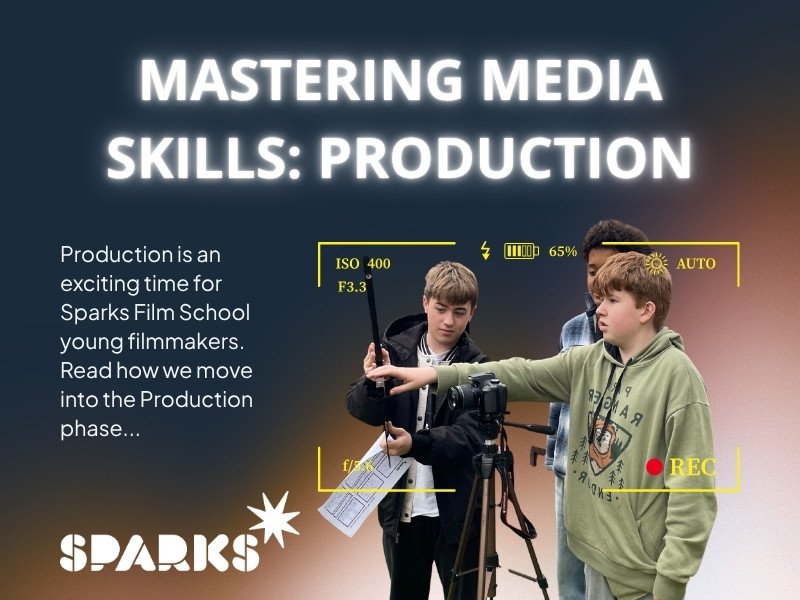
Take a look at what happens once the cameras are ready to roll at Sparks Film School
Sparks Film School filmmakers getting creative during Production

While the script is the soul of a film, the production phase is a film’s beating heart. It’s the bridge that connects the story to the screen. Production is the phase Sparks Film School students have been preparing for all term; the transition from masterclasses, techniques and pre-production to a full continuous production phase in which they shoot their film and turn their ideas and their scripts into film footage.
During the Production phase, students implement all the skills and techniques they have been covering for the first half of term, and then practically apply them to their own original film projects.
As anyone who has made a film or a TV production will recognise, Production is a rigorous, high-energy environment. Just like on a professional film set, students take on the roles of directors, cinematographers, actors, and other crew members to bring their cinematic visions to life. They work as professional film crew would, sharing roles and responsibilities across all areas of production.

The Culmination of a Term’s Hard Work
Throughout each term of filmmaking classes at Sparks Film School, students spend the first few weeks taking inspiration from and learning a wide range of filmmaking techniques and skills, always based on a theme each term. For example, one of the latest themes was ‘Raising The Stakes’, in which filmmakers focused on how to create and develop tension and suspense within their films.

Once they have pitched their ideas during Pitching Week, they are ready to go into the exciting phase of Production where they put all they have learnt into action, with creative freedom as a crew.
By the time they reach Production, they are feeling inspired and raring to go, full of ideas and new skills from the masterclasses covered. They start to synthesise everything they’ve learned about narrative structure and character motivation, applying it to the practical realities of a working set. It is the moment where the term’s theme moves from looking at film concepts and experimentation, to creating their own work within the styles of what they have been covering with their own ideas.
Production means getting creative with cinematography

Mastering the Lens: Camerawork and Dynamic Angles
A major focus of moving into the Production phase is the technical and artistic mastery of the camera. Young filmmakers are heavily encouraged to see the camera as one of their primary artistic tools, not just how to capture a clear image.
As part of our weekly filmmaking classes, students are always encouraged to move beyond “standard” eye-level shots. Students experiment with the below (to name just a few):
- Low-Angle Shots: To make a character appear more powerful or intimidating.
- Dutch Tilts: To create a sense of unease and psychological tension when a scene starts to go wrong.
- Extreme Close-Ups: To capture the subtle bead of sweat or the darting eyes of an actor, forcing the audience to feel the claustrophobia of a high-stakes moment.
By understanding the relationship between the lens and the viewer’s emotions, students learn that cinematography is about much more than “looking cool”. It’s about visual communication to an audience.

The Power of the Collective: Teamwork and Collaboration
If there is one thing that defines a Sparks Film School set, it is the spirit of collaboration. Filmmaking is perhaps one of the most collaborative art forms in the world, and the production phase is where students really learn the delicate balance of teamwork.
On a professional set, no one person can do everything. Our students rotate through roles, learning that the Director’s vision is nothing without the Cinematographer’s lighting and camera work, and the Editors’ attention to detail is what makes a scene look professional.

This environment fosters a unique type of creative collaboration. Young filmmakers learn how to:
- Communicate Ideas Clearly: Explaining a complex visual concept to a peer requires patience and precision. They develop these skills during pitching week too
- Negotiate Creative Differences: When filmmakers have different ideas for a scene (surprise, it does happen), they learn the art of creative compromise, finding a third way that often results in a better film
- Support One Another: The filmmakers learn to work towards the shared goal of creating a great film, supporting each other’s creative endeavours and working as a team to uplift each other’s work and the quality of what they create together.

Why The Production Phase Matters
Production is where theory becomes practice. It is where a filmmaker realises that the storyboard they drew three weeks ago actually works, or where they realise they need to innovate on the fly to make it even better. By the time “That’s a wrap” is called on the final day, the young filmmakers have developed a sense of resilience, a mastery of high-end equipment, and a deep-seated pride in their collective work.
They aren’t just making films; they are building the confidence to lead, to create, and to collaborate.
The Production phase is a vital part of the process within Sparks Film School’s filmmaking courses and it combines creativity, technical skill, and storytelling into some really fun weeks full of practical learning.

Ready to see your ideas on the big screen?
Interested to join? Sparks Film School offer weekly filmmaking classes where members pitch, direct, shoot, crew and edit their own short films.
Find your nearest film school and register for a Free Trial Class here >>
