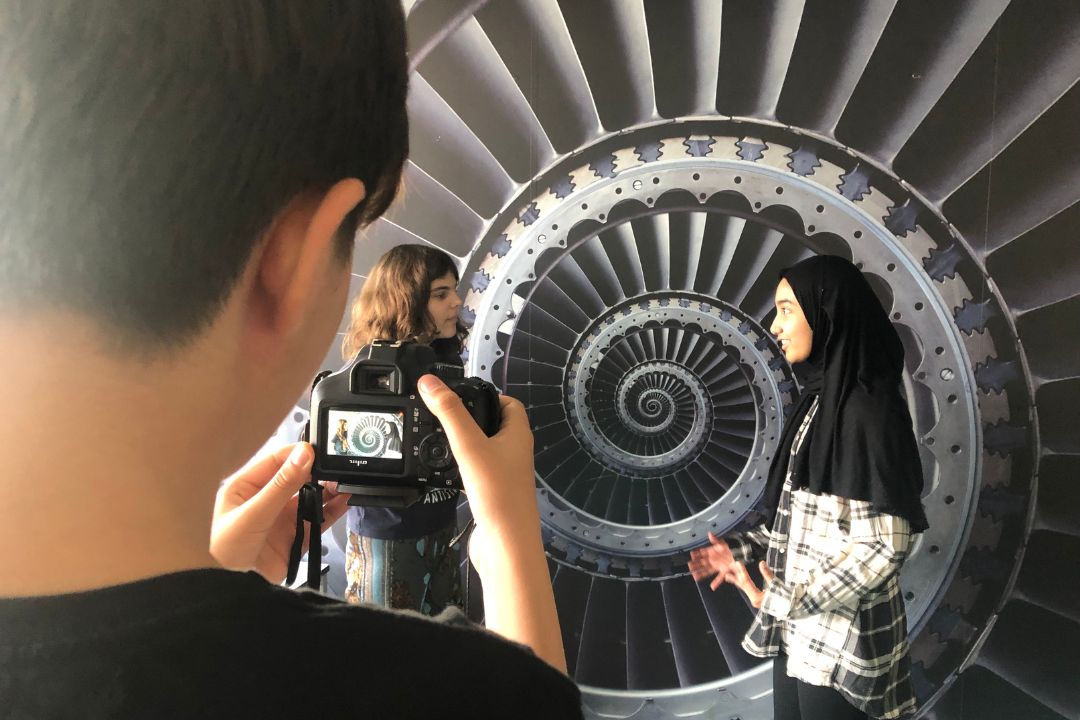
We’ve reached the halfway point in this term’s filmmaking challenge, The Camera Games.
As Sparks Film School students enjoy a well deserved half term break, we’re taking a look at all their progress and exploration from so far this term.
What are The Camera Games?
Each summer term, students taking part in Sparks Film School’s filmmaking classes take on a production challenge known as ‘The Camera Games’, which is designed to bring all their knowledge and learning together and give space for them to produce a piece of work that represents the best of their talents and skills development.

Every crew takes part in a series of production-focused masterclasses, then embarks on the adventure of producing their own unique film production. Each film is entered into a nation-wide competition, where a winning ‘Best Film’ production is awarded this year’s title. Our judging panel includes industry figures and film critics, who determine the winning film based on its merits and production quality.
So far this term…
The young film crews have been busy taking part in various masterclasses, each with a specific production focus.

Studio 1: Ages 5-7
In Studio 1, the youngest crew members are exploring different genres.
So far, they have looked at the key ingredients that go into spy films, mystery films and sci-fi films.
Within the different genres, they have been exploring how to use setting to help convey different worlds and different genre expectations. In a world-building set design session, the young crews set about imagining and then building different creative backdrops and props for different genres of film.

Studio 2: Ages 7-9
Filmmakers in Studio 2 have been exploring techniques that hone in on story development and world-building.
They have been seeking inspiration from award-winning films, including the recent adaptation of The Wonderful Story of Henry Sugar. The young crews set about creating their own short film sequences inspired by the style of narration and storytelling techniques found in the examples. This proved to be a really imaginative workshop, with an exciting array of possible stories and characters springing off the page.
The young filmmakers have been experimenting with different ideas for the world they may want to bring alive for the final film. In particular, they have been looking into sound design and how it can enhance mood and atmosphere.

Studio 3: Ages 9-11
Filmmakers in Studio 3 have been looking at recent Oscar winning short films for inspiration. One of the techniques they have chosen to explore is how to break the fourth wall. This is where a character “breaks” the concept of reality on screen and directly addresses the audience, or shows an awareness of themselves as a character.
During one recent workshop, filmmakers were inspired by the animation ‘Robot Dreams’. This film has no dialogue, and the story is heavily assisted through its sound design in achieving its tone and atmosphere.
The crews worked on some short film sequences of their own, which were led by the sound design. As part of this, the crews also had to record the individual sound FX too. They could see how much sound design and music can influence storytelling, a useful technique which they may like to use for their final film production.
Studio 4: Ages 11-14
In Studio 4, filmmakers have been looking at the cinematography styles of some BAFTA and Oscar winning films. The crews have studied specific examples from the work of DoP (Director of Photography) Hoyte van Hoytema, including the films Oppenheimer and Dunkirk.
After exploring the cinematography styles of these examples, the filmmakers created some short sequences of their own. These focused on character and camera movement, with an emphasis on central framing.
With central framing, the subject (eg; the main character) remains in the centre as the action happens around them, allowing the audience to focus in on the character without having to move our eyes or adjust our focus too much. The Studio 4 crews implemented this technique in their own work to great results.

So far this term, the Studio 4 crews have looked at how to write using an ‘Inciting Incident’. This is often how a story starts, by upsetting the balance of the main characters’ world and setting the story in motion.
The crews looked at the film Barbie as an example of how to setup and establish a world, then use an inciting incident to challenge the world’s status quo. They then devised and shot their own sequences using this framework of creating a setting, introducing an action and showing the result.
Studio 5: Ages 14-18
Studio 5 have been taking part in their own challenge-within-the-challenge, where they have been tasked to create independent edits of group footage.
The crews developed and shot footage that deliberately obscured the actor’s face. We saw crew members choosing inanimate objects to feature as main characters, and skilful silhouettes of actors carefully rehearsed and filmed together as a crew.
The Studio 5 crew members will each produce their own interpretation of the footage, with an individual edit of the sequence. The individual edits aim to show different approaches towards storytelling and different stylistic approaches. Once complete, the crew members will each evaluate their choices.

After Half Term
Once the crew members return after the half term break, they will all set about applying their knowledge and skills to their last film production of the year.
Every crew will produce their own original film, featuring all their chosen techniques from this term and from their time as young filmmakers.
These films will then be entered into The Camera Games competition, for the winning ‘Best Film’ to be decided.
We look forward to sharing them!
Find out more
The Camera Games features during the summer term of Sparks filmmaking classes.
In Sparks filmmaking classes, young filmmakers learn all about the different aspects of filmmaking together in age-tiered film crews. They explore the different roles found on a film set, as well as lots of different production techniques. They develop skills as young producers, directors, screenwriters, camera and production crew, as well as acting for camera and editors too.
Find out more about Sparks filmmaking classes here >>
