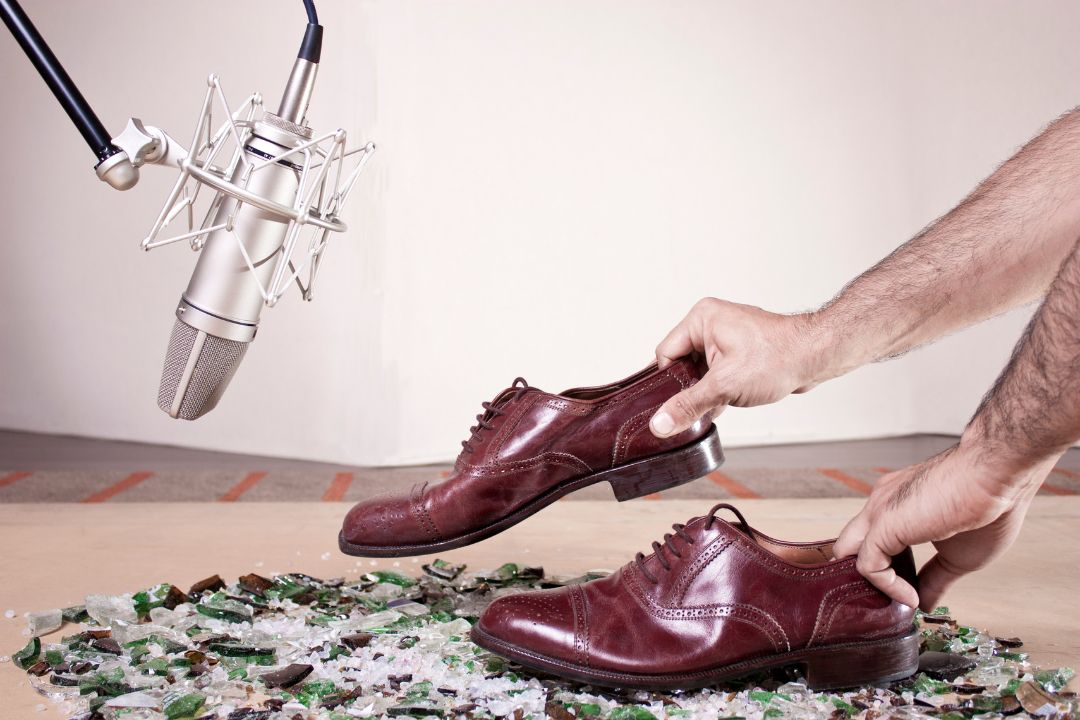
What is a Foley Artist?
A Foley Artist is a sound effects specialist who creates and records everyday sound effects to enhance the audio experience in films, television shows, video games, and other media.
Named after Jack Foley, a pioneer in sound effects for film, these artists focus on creating custom sound effects that reproduce or mimic real sounds, with the effects then added to the audio track in post-production.
Foley artists work as part of a sound team, where they create original sounds, which are recorded live. From footsteps to fight scenes, they help to bring authentic sounds to enhance and enrich a film’s soundtrack.
Why use Foley sounds?
Sounds created in post-production like Foley sounds tend to be higher quality and more impactful than sounds recorded in a production environment like a live film set. Foley sounds are usually produced by specialist Foley artists in a highly controlled environment, so unlike recordings made on set, they can be carefully produced with specific focus.
Unique, original foley sounds also help to bring individual character to the soundtrack. Although library sound effects can be effective and are much more accessible, they are usually widely available and used across a number of different productions. Using original foley sounds mean that a production’s soundtrack will have its own unique sound profile and they can also be created to order so that each sound is exactly as desired.
Foley adds depth and realism to a film or show, making the audience feel more engaged with the story. Without Foley, many scenes would feel flat or unnatural, as the audio would lack the subtle details that make the environment believable.
How to Create Foley Sounds
For Foley artists, there is a lot of imagination involved and a lot of research, experimentation and trial and error.
It might seem simple to think of recording footsteps, but when you start to think about the differences in surface textures, footwear, costumes and fabric items, character stance/weight/gait/emotional state and so on, you can quickly find yourself with the need for many different kinds of footsteps performed with different props and materials. Some Foley artists specialise solely in footstep creation!
It can be even more of a challenge to to conceive of sound effects for actions that might not exist in real life. What does a spaceship in 3024 sound like when it takes off? How do you create and record that sound using materials available today?
Top Tips for Producing Your Own Foley Sound Effects
- Food items like vegetables and raw meat make great violent, bodily sounds. Try chopping a cabbage and letting it roll for the sound of a medieval beheading!
- Collect in sample surfaces to use for footsteps or as ground sounds. Find and collect gravel in different sizes, some turf or astroturf, dried leaves, sand… Bags of flour can work brilliantly as snow or ice, give it a try!
- You can create weather sounds easily using lots of household items. Sprinkle rice, birdseed, or coarse sand on a metal sheet or other thin surface. Slowly run your fingers over a pine cone to mimic the sound of ice cracking.
- Cold running water sounds different than hot running water, and flows can sound very different depending on pressure and volume. Record your own foley sounds at different temperatures, speeds and with different volumes of water, see if you can hear all the differences and imagine scenes for them.
- If you have one, try to use a microphone to record your Foley sound effects and make sure it’s close to the sound source. Try to keep background noise to a minimum, choose a quiet space in which to record.
- Once you’ve recorded them, you can edit your Foley sound effects to remove background noises, isolate sounds and tailor them to your preferences. For this, we recommend a specialist sound editing programme, such as Adobe Audition, Audacity or Logic Pro.
Learn More about Foley Artists in Sparks Film School Programmes
Sparks Film School offer youth filmmaking programmes for ages 5-18. Students taking part in our term time courses explore different aspects of sound production.
Students in Studios 4 and 5 (ages 11+) learn how to work with specialist sound recording equipment, with students in Studios 1-3 (ages 5-11) exploring some of the basics of sound in filmmaking.
We’ll be exploring the work of Foley artists and foley sound effects as part of our upcoming term.
Find out more about our filmmaking courses >>>
